
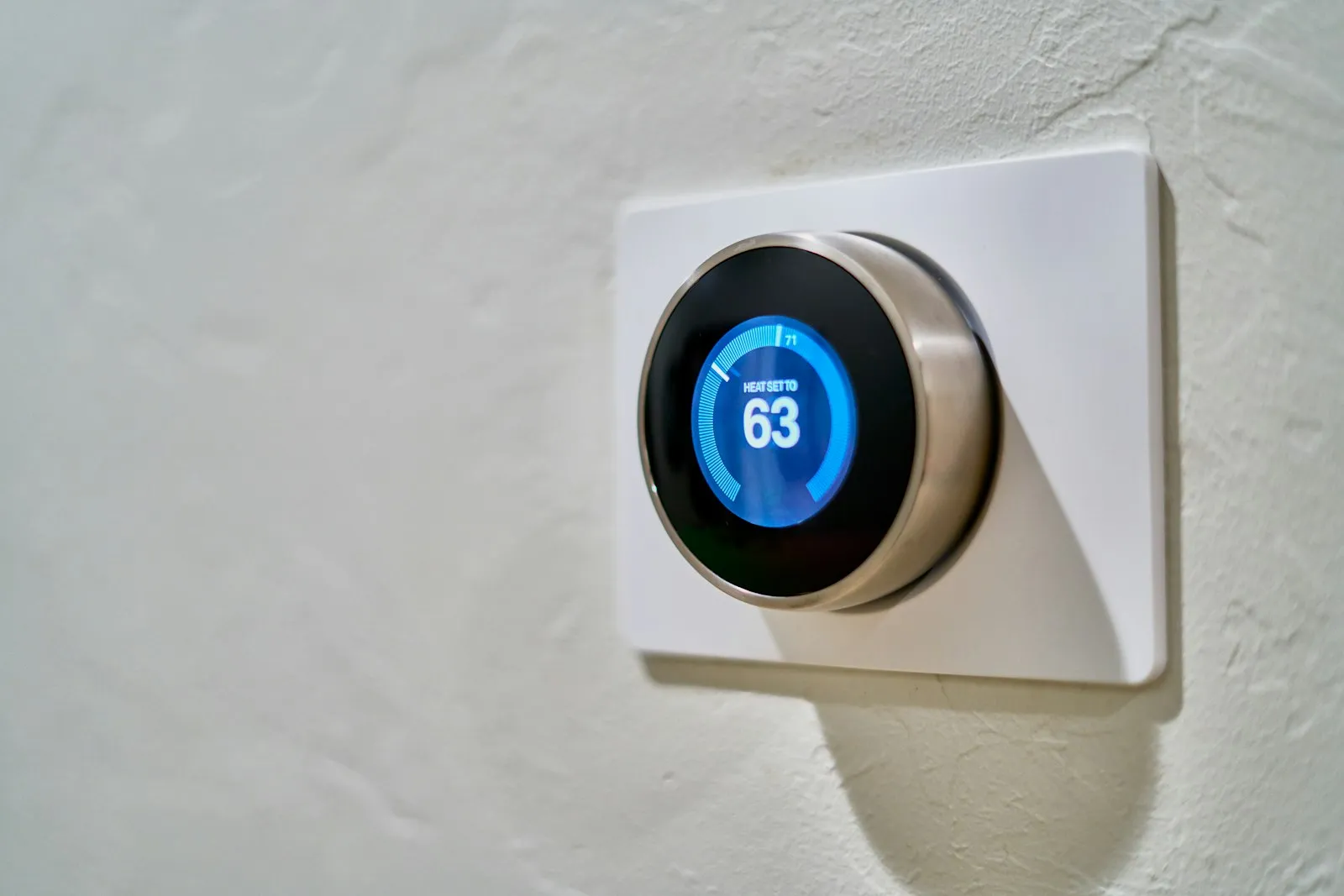
- Smart thermostat: your combi boiler or heat pump on a weekly schedule, adjustable from your phone.
- Room-by-room control: smart radiator valves or actuators on the underfloor heating manifold so each room holds its own temperature.
- Air conditioning integration: split or VRF units linked into the system and included in scenes.
- Window and door contacts: heating or AC in a room stops when the window opens.
- Presence detection: the system drops to eco mode when nobody is home and returns to comfort mode as you head back.
Smart Climate Control
Run your boiler, underfloor heating and air conditioning room by room and hour by hour. Heating stops when a window opens.
- Room-by-room temperature control
- Boiler and underfloor heating schedules
- Air conditioning integration
- Auto shut-off when a window opens
How it works at home
Smart Climate Control in everyday life
Heating and cooling account for a large share of a home's energy use, yet most homes still run everything off a single thermostat in the hallway. Smart climate control changes that. Each room gets its own temperature and each part of the day its own setting.
Home control07:00
Room-by-room temperature control
01/05
What smart climate control covers
02/05
Example scenarios
A warm bathroom in the morning
On weekdays the bathroom underfloor heating starts at 06:30, so the floor is warm by the time you get up. At weekends the same program starts an hour later. You don't have to touch anything each morning.
The window you forgot
You opened the bedroom window to air the room and forgot about it. A contact sensor on the window picks this up and closes that room's valve or switches off the AC. Once the window is shut, the system carries on as before.
Coming home to a warm house
When you leave work, one tap on your phone or a location-based rule switches the heating to comfort mode. You don't walk into a cold house in winter, and you haven't heated an empty home all day either.
03/05
Boilers, underfloor heating and AC: how they connect
Homes with a combi boiler
Most flats in Samsun are heated by a gas combi boiler. The majority of boilers accept on/off commands through a room thermostat connection, and some support communication protocols such as OpenTherm for finer modulation. We check what your boiler supports during the survey and choose the thermostat to match.
Underfloor heating
With underfloor heating, an actuator on each circuit of the manifold lets you control rooms separately. Because underfloor heating reacts slowly, schedules need to start a little ahead of time. We set that up during installation.
Air conditioning
AC units connect in different ways depending on the make and model: the manufacturer's own Wi-Fi module, KNX or Modbus interfaces, or infrared (IR) blasters. A wired interface gives reliable feedback. IR is a handy option for older units, but it can't always tell you what state the unit is actually in.
04/05
New build or existing home?
During construction you can plan cabling for room sensors, underfloor actuators and AC interfaces. In a KNX home, that puts climate control on the same system as lighting and blinds. In a home you already live in, you can start without any building work using a smart thermostat, battery radiator valves and wireless window contacts.
05/05
Things to keep in mind
- Heating system compatibility: the thermostat needs to match the connection your boiler or heat pump supports.
- Sensor placement: a room sensor on a sunny wall, above a radiator or next to the hob will give false readings.
- Humidity: the Black Sea climate is humid. Some systems can also run ventilation or a dehumidifier based on humidity readings, and we can add that to the plan if you need it.
- Manual control: you should always be able to change the temperature on the thermostat itself, even if the app is down.
Heating and cooling have a direct effect on your bills. If you want to measure and see your consumption, it is worth pairing this with smart energy management. To look at your home's heating and cooling together, book a site survey.
Better together
All services Systems that work alongside this one
01
Motorised Blinds & Shutters
Curtains, roller blinds and shutters that open and close by time, sun and wind. Battery motors available for existing homes.
Learn more 02Smart Lock Systems
Open your door with a code, card, fingerprint or phone. Give guests time-limited codes and see who came in and when.
Learn more 03Fire & Flood Safety
Smoke, heat, gas and water leak sensors alert your phone. If a pipe leaks, a motorised valve shuts off the water supply automatically.
Learn moreHow we work
From first visit to handover in four steps
Smart home projects go wrong when decisions get made on the day of installation. So we split the job into clear stages from the start.
- 01
Site survey
We visit the home or the building site and look at the wiring, windows and heating system. We also ask how you actually live in the space.
- 02
Design
We put together a written plan: what gets controlled in each room, wired or wireless, and which scenes you want. You review it with us before any work starts.
- 03
Installation & programming
We fit the devices, program the system and test every scene on site. On renovation jobs we work to the same schedule as your electrician and other trades.
- 04
Training & support
At handover we walk through the app, the wall panels and the scenes together. If you want to change a scene or add a device later, just get in touch.
It works with most boilers that have a room thermostat input, at least at on/off level. Finer control needs a protocol like OpenTherm, which we check during the survey.
Usually, via an infrared blaster. It is practical, but it can't always report the unit's real state, so newer models are better connected over Wi-Fi or a wired interface.
In homes with radiators, a smart valve on each radiator is often enough. Underfloor heating uses room sensors together with actuators on the manifold.
Let's plan your smart home
Building new or upgrading the place you already live in? Tell us a little about the property and we will get back to you to arrange a site survey.